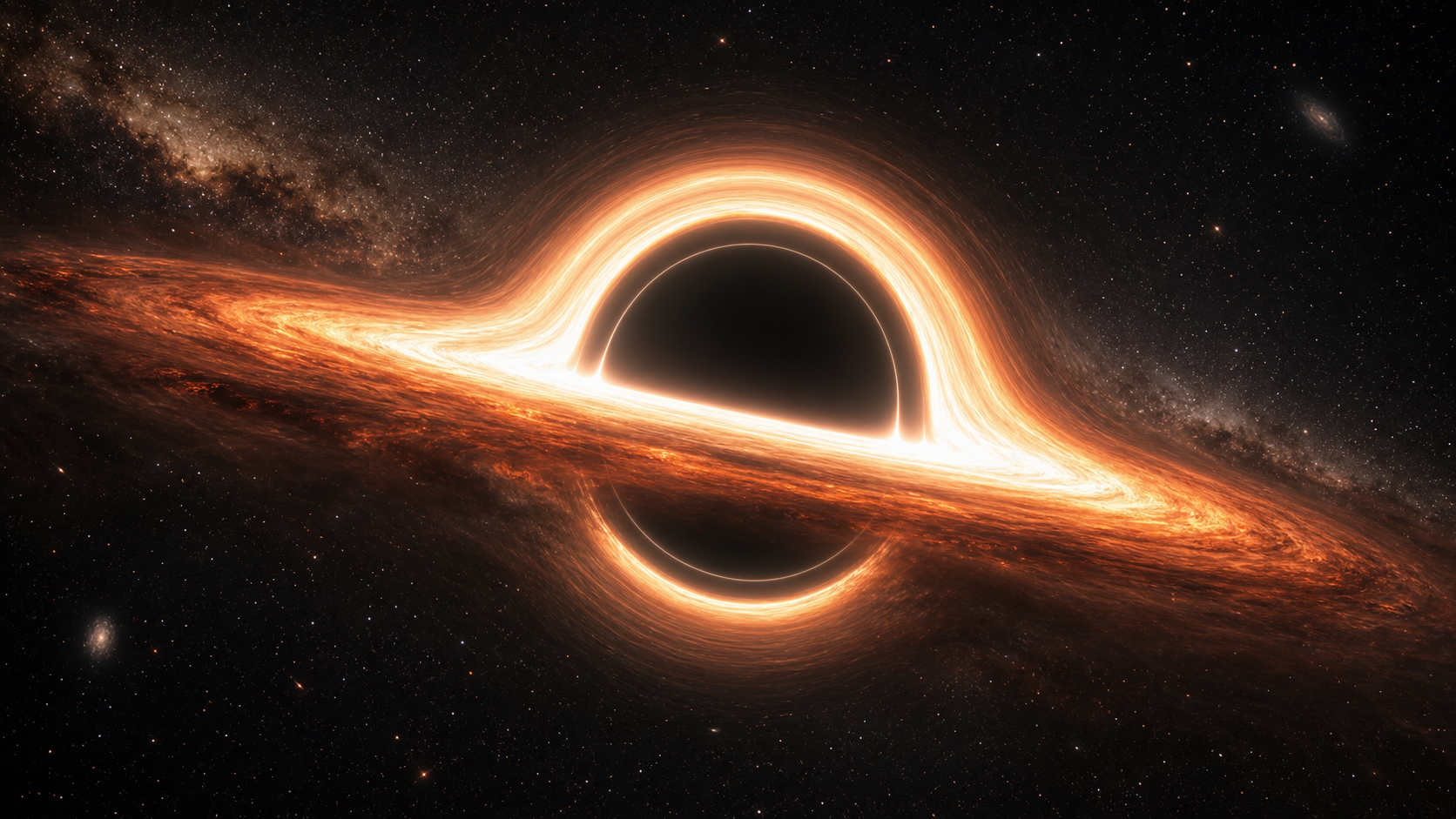
Black holes are the darkest, strangest, and most fascinating objects in the universe. They warp space and time, swallow light, and challenge the very foundations of modern physics. And yet, for all their cosmic significance, most of what the average reader knows about them comes from Hollywood movies or half-remembered science class analogies.
Beyond the Event Horizon sets out to change that — and it succeeds.
What This Book Covers
Written in clear, accessible language, Beyond the Event Horizon takes readers on a journey from the birth of black holes in dying stars to the mysteries hidden beyond the event horizon itself. This isn't a textbook. It's a guided tour through some of the most mind-bending concepts in astrophysics, made approachable for anyone with a genuine curiosity about the cosmos.
The book explores how black holes bend time and space, influence entire galaxies, and sit at the intersection of general relativity and quantum mechanics — two frameworks that, famously, don't fully agree with each other.
Key Topics Explored
- The birth and death of stars — how stellar collapse creates black holes in the first place
- Singularities — what happens when matter is compressed to an infinitely small point
- Hawking radiation — Stephen Hawking's groundbreaking insight that black holes aren't entirely black
- Gravitational lensing — how black holes bend light from distant objects, creating cosmic magnifying glasses
- The information paradox — one of the deepest unsolved problems in theoretical physics
- Supermassive black holes — the monsters at the centres of galaxies, including our own Milky Way
- Time dilation near the event horizon — why time itself slows down as you approach a black hole
Why This Book Stands Out
There's no shortage of popular science books about space. What makes Beyond the Event Horizon worth your attention is its tone. Complex ideas — singularities, Hawking radiation, gravitational lensing, the information paradox — are explained in a way that is engaging, cinematic, and genuinely easy to follow. You won't need a physics degree to keep up.
The writing treats readers as intelligent adults who are curious but not necessarily trained scientists. That balance is harder to strike than it sounds, and the author handles it well. Each concept builds on the last, creating a narrative arc that feels more like a documentary than a lecture.
Who Is This Book For?
Perfect for space enthusiasts, curious readers, and anyone drawn to the mysteries of the cosmos. Whether you've followed astrophysics for years or you're just starting to wonder what's really out there, this book meets you where you are.
- Science and space enthusiasts looking for their next great read
- Curious readers who want to understand black holes without the jargon
- Students exploring astrophysics and cosmology concepts
- Anyone fascinated by the big questions — what is the universe made of, and what lies at its most extreme edges?
Get Your Copy of Beyond the Event Horizon
Available now as a PDF — a thrilling journey into one of the universe's greatest wonders.
Buy Now — £9.98 →The Science of Black Holes, Simplified
How Black Holes Form
Every black hole begins with a star. When a massive star — typically more than about 20 times the mass of our Sun — exhausts its nuclear fuel, it can no longer support itself against its own gravity. The core collapses in a fraction of a second, and if it's massive enough, nothing can stop the implosion. What remains is a region of space where gravity is so intense that not even light can escape.
This boundary is the event horizon — the "point of no return" that gives the book its name.
What Happens Beyond the Event Horizon
This is where physics gets genuinely strange. Beyond the event horizon, our current understanding of the laws of physics begins to break down. General relativity predicts that all the matter that falls into a black hole is compressed into a singularity — a point of infinite density and zero volume. But quantum mechanics suggests that information can never truly be destroyed, creating one of the great unresolved tensions in modern physics.
The book walks through these ideas without hand-waving past the hard parts or drowning readers in equations. It acknowledges what we know, what we think we know, and what remains genuinely mysterious.
Hawking Radiation and the Black Hole Information Paradox
One of the most fascinating chapters covers Stephen Hawking's 1974 discovery that black holes aren't perfectly black — they emit a faint glow of radiation, now called Hawking radiation. This insight connected general relativity, quantum mechanics, and thermodynamics in ways that nobody had anticipated.
But it also created a paradox: if a black hole can evaporate over time through Hawking radiation, what happens to all the information about the matter that fell into it? Is it destroyed? Encoded in the radiation? Stored on the event horizon itself? Physicists are still debating the answer, and the book lays out the competing theories with clarity and fairness.
Gravitational Lensing — Seeing with Gravity
Black holes don't just swallow light — they bend it. When a black hole sits between us and a distant light source, its gravity curves the light around it, creating distorted, magnified, or multiplied images. This effect, called gravitational lensing, has become one of the most powerful tools in modern astronomy for detecting dark matter, measuring cosmic distances, and finding objects that would otherwise be invisible.
The Bigger Picture
What makes Beyond the Event Horizon more than just a science explainer is its sense of scale. The book consistently connects the physics of individual black holes to the larger story of the universe itself — how supermassive black holes shape galaxies, how merging black holes produce gravitational waves we can now detect, and how studying these extreme objects pushes the boundaries of human knowledge.
It's a reminder that some of the most important questions in science aren't just technical — they're philosophical. What is the nature of space and time? Can information be truly lost? What does it mean for a region of space to be fundamentally unknowable?
Final Verdict
Beyond the Event Horizon offers a thrilling journey into one of the universe's greatest wonders. It's the kind of book that makes you look up at the night sky differently after finishing it. For anyone who has ever been fascinated by the idea that the universe contains objects so extreme they break our understanding of reality, this is a deeply satisfying read.
Available now as a downloadable PDF. Get your copy of Beyond the Event Horizon here →